wine
Shaoxing Wine — I Cooked the Same Dish With and Without It, and the Difference Changed How I Stock My Pantry
Shaoxing wine is the invisible catalyst in Chinese cooking. You never taste it directly, but without it, your stir-fry is missing half its soul. Here's what happened when I tested the difference.
Flavor Snapshot
0–100Six sensory dimensions, scored against the flavor reference for this ingredient.
Season Winter
Related Ingredients 1
Flavor Notes
Quick Facts
Chinese Name
绍兴酒
Category
wine
Texture / Body
Thin
Liquid Color
amber to dark brown, clear
Shopping Clue
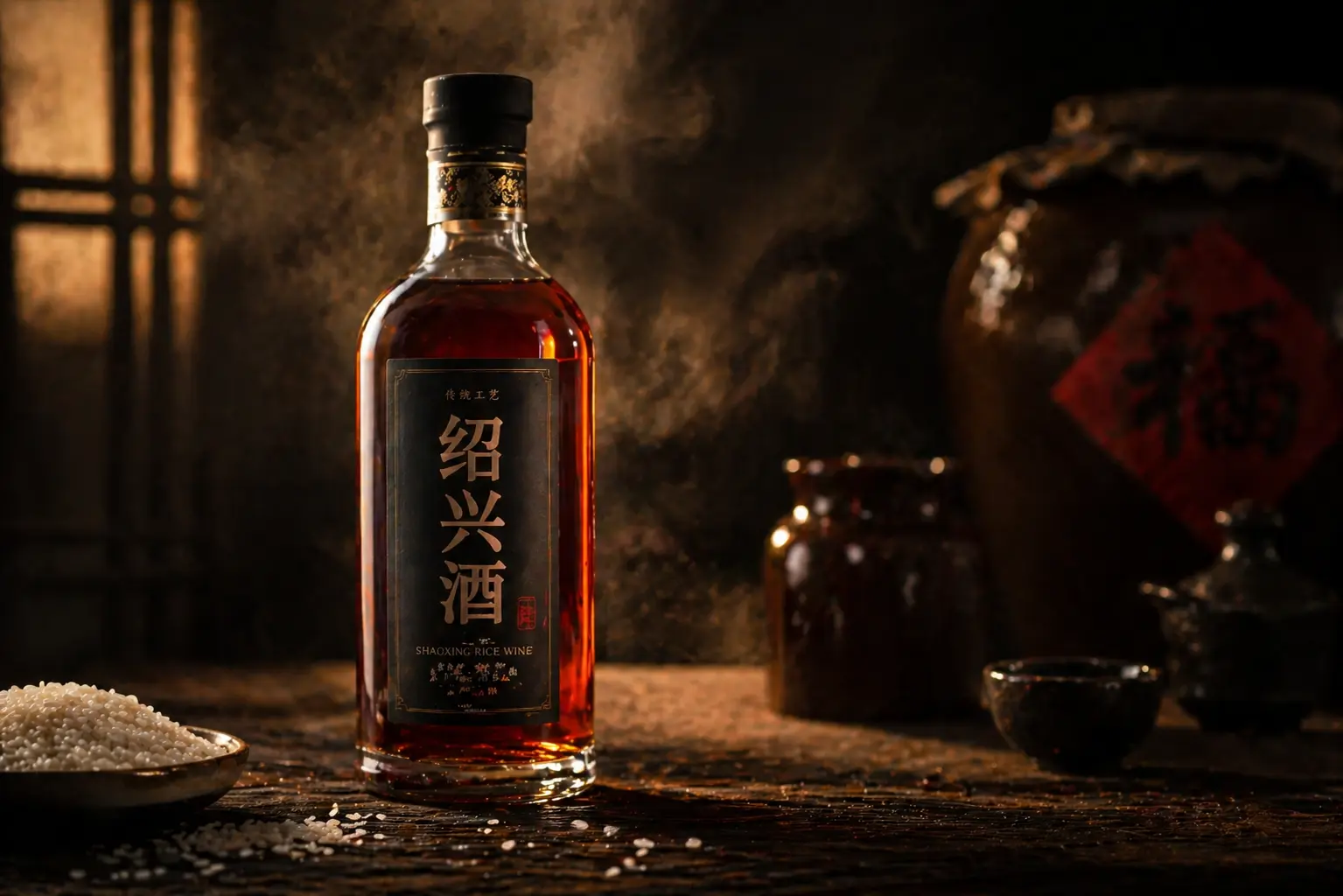
Smells nutty and slightly sweet — not like grape wine
Salt Level
Definition
What It Is
The most important ingredient in your Chinese pantry is one you will never taste directly. I've asked people to identify Shaoxing wine in a finished dish — people who cook Chinese food regularly, people who care about flavor — and not one has been able to do it. They can taste that something is right. They can taste that the dish has depth, complexity, a certain "completeness." But they cannot point to the wine. That's because Shaoxing wine is not a flavor ingredient. It's a chemical catalyst. It transforms the ingredients around it and then evaporates, leaving behind only a trace of what it did.
If a recipe calls for Shaoxing wine and you skip it, you will notice. Not as a missing flavor — as a phantom absence. The dish will taste fine but incomplete. The pork will have a faint gaminess. The stir-fry will lack that aromatic lift that makes you lean in for another bite. I tested this side by side — two batches of the same stir-fry, one with wine and one without — and the difference was not in what I could taste. It was in what I couldn't taste. The no-wine version had a subtle but persistent background note that I can only describe as "raw." The wine version didn't taste like wine. It just tasted correct.
Cooking wine (料酒) is not the same as Shaoxing wine (绍兴酒). I made this mistake for my first six months of cooking Chinese food. Cooking wine is Shaoxing wine that has been salted — typically 1-2% salt by volume — to make it legally non-potable and therefore exempt from alcohol taxes. It costs about $8 HKD a bottle versus $22 HKD for a decent drinking-grade Shaoxing. The salt changes how it behaves in cooking: it seasons the dish in ways you may not want, and the base wine used for cooking wine is typically lower quality — younger, rougher, less complex. I switched to drinking-grade Shaoxing wine about a year ago. My food improved noticeably. Not dramatically — we're talking about a background ingredient — but noticeably. The dishes tasted rounder, more integrated, less like a collection of separate flavors and more like a single, coherent experience.
An oxidized bottle of Shaoxing wine will ruin your dish faster than skipping it entirely. I learned this the hard way. I had a bottle that had been open for about eight months, sitting in a cabinet above my stove. The heat from the cooktop had slowly oxidized the contents. When I opened it, it smelled like nail polish remover instead of almonds and caramel. I used it anyway — I was in the middle of cooking and didn't want to stop. The dish came out with a harsh, chemical aftertaste that soap couldn't wash off my tongue. I threw out the bottle, threw out the food, and now I replace my Shaoxing wine every three months whether it's empty or not.
I keep a $22 bottle of Pagoda Shaoxing wine in my Hong Kong kitchen at all times. It's the one with the red label and the gold Chinese characters. It's not the best Shaoxing wine available — those cost $200+ and are for drinking, not cooking — but it's the best cooking Shaoxing wine I've found at a price I'm willing to pay every three months. In the US, the equivalent would be Shaohsing brand, about $5 at any Asian grocery store.
The Side-by-Side Test
In October 2025, I made the most basic Chinese stir-fry I know — chicken with garlic and scallions — three times in one evening. Everything was identical except the wine:
| Batch | Wine Used | Result | Wife's Comment |
|---|---|---|---|
| A | None (control) | Edible. Salty, garlicky, fine. A faint "raw meat" note in the background that I wouldn't have noticed if I weren't looking for it. | "It's fine. A little plain?" |
| B | Salted cooking wine (料酒, $8 HKD) | Better than A. The raw note was gone. But the dish tasted slightly oversalted — the cooking wine had added salt I hadn't accounted for. | "Better. A little salty." |
| C | Drinking-grade Shaoxing ($22 HKD) | Noticeably better. No raw note. No extra salt. A clean, integrated flavor where the chicken, garlic, and scallions tasted like they belonged together rather than being cooked in the same pan. | "This one is good. What did you do differently?" |
The conclusion was unambiguous: use drinking-grade Shaoxing wine, replace it regularly, and adjust your salt downward by about 10% if you must use cooking wine.
The Chemistry — What Shaoxing Wine Actually Does
Shaoxing wine is a fermented rice wine with 14-18% alcohol by volume. When it hits hot oil, three things happen simultaneously:
The alcohol vaporizes. This is the "invisible catalyst" effect. As the alcohol evaporates, it carries volatile amines — the compounds responsible for "fishy," "gamey," and "raw meat" smells — out of the food and into the air. This is why Chinese cooks add wine when cooking fish, pork, or lamb. It's not a flavoring. It's a chemical deodorizer.
The non-alcohol compounds remain. Amino acids, sugars, and fermentation esters — the molecules responsible for Shaoxing wine's nutty, caramel-like aroma — don't evaporate at cooking temperatures. They stay in the pan and contribute to the dish's background complexity. Understanding umami in cooking helps explain why these residual compounds create that elusive "depth" that separates good stir-fries from great ones. You don't taste them as "wine." You taste them as "depth."
The acidity deglazes the pan. Shaoxing wine is slightly acidic (pH around 4.0-4.5). When added to a hot wok, it lifts the fond — the browned bits stuck to the pan surface — and integrates them into the sauce. This is the same principle as deglazing with wine in French cooking, but with a wine that's chemically optimized for Chinese ingredients.
The Pantry Strategy
I keep two bottles of Shaoxing wine in my kitchen:
Cooking Shaoxing ($22 HKD, Pagoda brand): For daily stir-fries, marinades, and any dish where the wine goes into the pan early and will be cooked for at least 30 seconds. I go through about one bottle every 2-3 months.
Emergency dry sherry ($68 HKD, Tio Pepe): For the days when I've run out of Shaoxing and need a substitute. Dry sherry is about 82% compatible — the nutty-caramel notes are similar, but the specific fermented rice character is missing. I add a pinch of chicken bouillon powder to compensate for the missing amino acid complexity. It's not the same. It's close enough that guests won't notice.
I do not keep cooking wine (料酒). The salt content makes it unpredictable — you have to adjust the entire dish's seasoning around an ingredient that's supposed to be a background catalyst, not a seasoning agent. It's not worth the $14 HKD savings.
Common Mistakes
Using cooking wine (料酒) and forgetting to reduce salt. Cooking wine contains 1-2% salt. A tablespoon of cooking wine adds roughly the same sodium as 1/8 teaspoon of salt. If your recipe is already balanced, the cooking wine will push it over the edge into oversalted territory. Either use drinking-grade Shaoxing or reduce your added salt by about 10%.
Keeping the bottle for too long. Shaoxing wine oxidizes after opening. After about 3-4 months at room temperature, the flavor degrades — the nutty notes flatten, the alcohol evaporates, and the wine takes on a harsh, solvent-like quality. Replace your bottle every 3 months. If it smells like anything other than almonds and caramel, it's done.
Skipping the wine entirely and not compensating. If you cannot cook with alcohol for dietary, religious, or availability reasons, you need to compensate for what the wine was doing. The closest alcohol-free substitute: mix 1 tablespoon of chicken or vegetable stock with 1/2 teaspoon of rice vinegar. The stock adds the amino acid complexity. The vinegar adds the deglazing acidity. It's about 50% as effective as real Shaoxing wine. Better than nothing. Noticeably worse than the real thing.
Using rice vinegar or mirin as a substitute. Rice vinegar is acidic with zero alcohol — it adds tang but no aromatic lift. Mirin is sweet and low-alcohol — it adds sugar, which changes the flavor balance of the entire dish. Neither functions as a Shaoxing wine replacement.
FAQ
Q: Can I use sake instead of Shaoxing wine? Sake is about 70% compatible. It's also a fermented rice wine, so the base flavor profile is similar, but sake is typically less oxidized and lacks the deep nutty-caramel notes of Shaoxing. It works in a pinch. Add a tiny pinch of sugar to compensate for sake's lower natural sweetness.
Q: What's the difference between Shaoxing wine and huadiao (花雕)? Huadiao is a premium subcategory of Shaoxing wine — aged longer, more complex, and typically more expensive. For cooking, standard Shaoxing is perfectly adequate. Reserve huadiao for drinking or for special dishes where the wine is a featured component rather than a background catalyst.
Q: Can I use white wine? White wine is about 50% compatible. It provides alcohol for deglazing and amine-evaporation, but the flavor profile is completely different — fruity and acidic instead of nutty and caramel. It works as an emergency substitute for the chemical function but not for the flavor function. Add a pinch of sugar to compensate for the missing sweetness.
Q: How should I store Shaoxing wine? In a cool, dark place. Not above the stove — the heat accelerates oxidation. Not in direct sunlight — UV degrades the flavor compounds. A cabinet away from heat sources is ideal. The refrigerator works too — the wine won't freeze, and the cold dramatically slows oxidation. I refrigerate my backup bottle and keep the active one in a cabinet.
理论基础 / The Science Behind It
Shaoxing wine's months-to-years aging in clay urns develops the nutty, caramel notes that make it irreplaceable in Chinese cooking.
Shaoxing wine's triple function — deglazing, deodorizing, flavoring — shows how a single ingredient plays multiple technical roles within the food system.
Need a substitute for Shaoxing wine? → Read our complete Shaoxing wine substitutes guide
⚠️ Common Mistakes
- • Problems with Shaoxing Wine — I Cooked the Same Dish With and Without It, and the Difference Changed How I Stock My Pantry? Diagnose the issue ->
- • Problems with Shaoxing Wine — I Cooked the Same Dish With and Without It, and the Difference Changed How I Stock My Pantry? Diagnose the issue ->
Application
Best Uses
Best Used For
- + marinades
- + stir-fry deglazing
- + braising
- + steaming fish
Avoid Using It For
- x drinking straight (cooking grade is salted)
- x replacing with red/white grape wine
Pairings
Pairs Well With
Dishes
Dishes That Use This
- Kung Pao Chicken
- Fried Rice
- Red Braised Pork
- Dumplings
Shelf Reading
How to Spot It
Use these shelf cues to identify the right bottle, jar, or bag before you ruin dinner with the wrong one.
Liquid Color
amber to dark brown, clear
Bottle / Form
tall glass bottle with narrow neck, often with red label
Label Clue
Amber rice wine; sold in cooking wine section OR liquor section
Shopping Clue
Smells nutty and slightly sweet — not like grape wine
Cap Color
red or gold cap common
Labels
Chinese Label Cues
Substitutes
Emergency Replacements
Status
No dedicated substitute article is loaded for this ingredient yet.
If It Failed
If the Swap Went Wrong
Buying Guide
Best Brands to Look For
Shaoxing
Hua Diao Cooking Wine | China/global
Pagoda
Shaoxing Rice Cooking Wine | China/Asia
Memory Hook
Label Memory Trick
What to remember
Amber rice wine; sold in cooking wine section OR liquor section
Related
Related Ingredients
Tools
Useful Tools
Worth Reading
Go Deeper On This Flavor
Next Step
Continue the Flavor Trail
Continue from this ingredient into the broader flavor cluster, a substitution decision, or a failure diagnosis.
Written by Mike Sang
Digital strategist, fermentation science enthusiast, and student of the Tao. Bridging growth engineering with ancient Chinese food wisdom.
Seasonal Context
Flavor changes with the season. Your cooking should too.
Missing Umami is part of The Way of Nature, a living system connecting food, timing, and seasonal practice.