soy sauce
Light Soy Sauce — The Seasoning Backbone of Chinese Cooking
Light soy sauce is the salt and umami engine of Chinese cuisine. If you only own one Chinese sauce, make it this one.
Flavor Snapshot
0–100Six sensory dimensions, scored against the flavor reference for this ingredient.
Season Spring
Related Ingredients 2
Flavor Notes
Quick Facts
Chinese Name
生抽
Category
soy sauce
Texture / Body
Thin
Liquid Color
dark reddish-brown, translucent
Shopping Clue
Pours like water — thin and fast
Salt Level
Definition
What It Is
The Day I Realized I'd Been Wrong for Years
I stood in my kitchen in Chengdu, Sichuan, holding two identical-looking bottles of brown liquid. My Chinese mother-in-law watched me pour from the wrong one into her prized twice-cooked pork. She didn't say a word. She just took the bottle from my hand, set it aside, and handed me the other one. That silent correction taught me more about Chinese cooking than any cookbook ever could.
The wrong bottle? Dark soy sauce. The right one? Light soy sauce — 生抽 (shēng chōu). In that moment, I understood that to a Chinese cook, these are as different as salt and caramel syrup. You wouldn't season a steak with caramel. You shouldn't season a stir-fry with dark soy.
What Light Soy Sauce Actually Is
Light soy sauce is the first-press extraction from fermented soybeans. After months of natural fermentation — soybeans + wheat + salt + koji mold (Aspergillus oryzae) — the liquid that naturally rises to the top is drawn off. This is light soy. It's thin, deeply savory, and packed with glutamates.
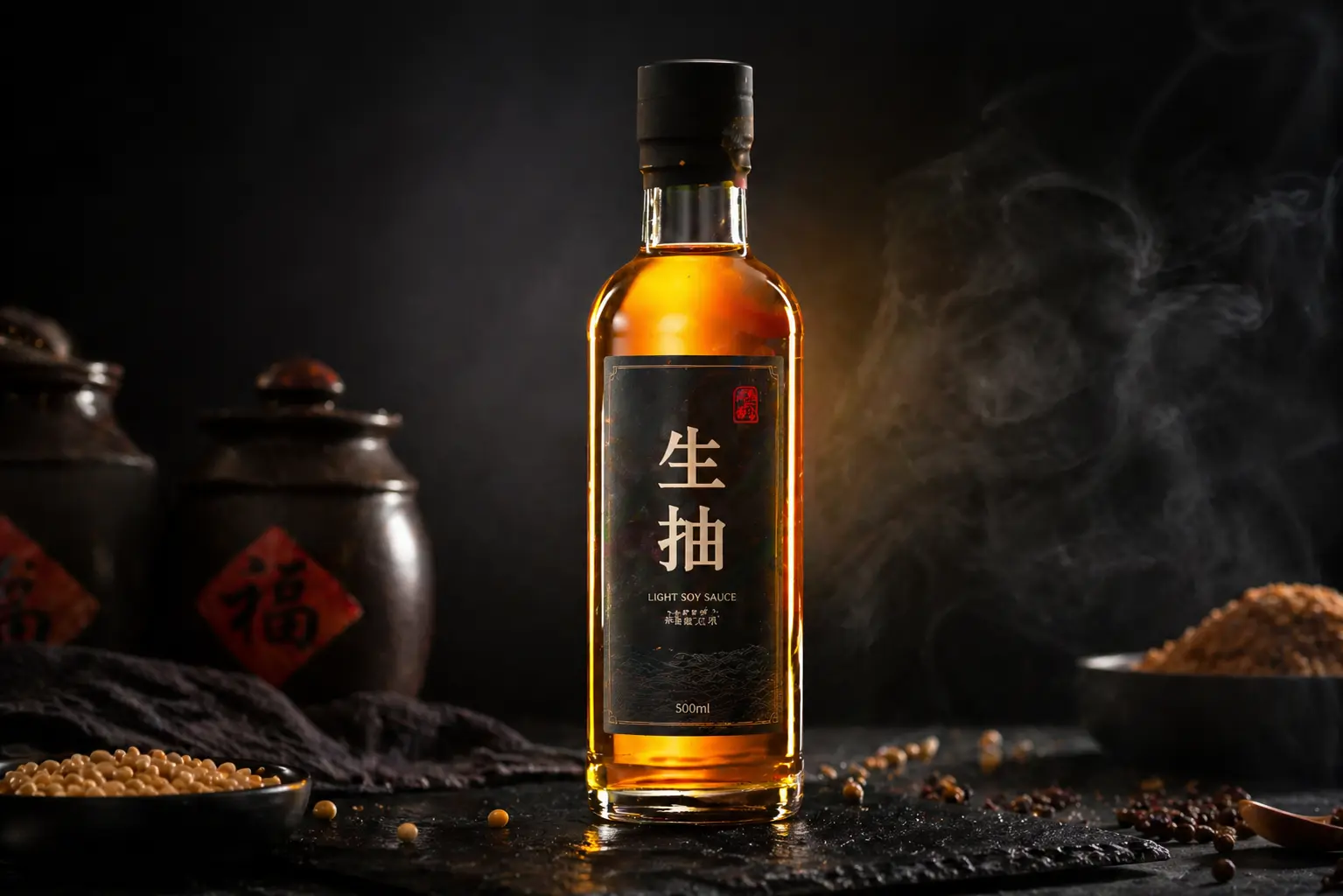
The Chinese character 生 (shēng) means "raw" or "fresh." 抽 (chōu) means "to draw out." Together: "freshly drawn." It's the soy sauce that hasn't been aged further or mixed with molasses for color. It pours like water — thin, translucent reddish-brown, with a clean salty-umami punch that hits the back of your tongue immediately.
I've tasted it straight from the bottle more times than I can count (don't judge me — quality control). The sensation: salt first, then a wave of savory richness that spreads across your palate, then a faint sweetness that lingers. There's a sharpness to it that dark soy lacks — a bright, almost metallic edge that awakens the other flavors in a dish.
The Science of the Umami Punch
Here's what makes light soy sauce the MVP of Chinese cooking: its glutamate content. What is umami? Naturally brewed light soy sauce contains approximately 800-1200 mg of glutamic acid per 100ml. That's the same umami compound found in Parmesan cheese, tomatoes, and kombu seaweed. The glutamates in light soy activate the same taste receptors that make us perceive savory depth — the very essence of the fifth taste.
When you add light soy to a hot wok, something remarkable happens. The heat triggers the Maillard reaction between the soy sauce's amino acids and the food's natural sugars. This creates hundreds of new flavor compounds — the same reaction that gives seared steak its crust. But in a wok, it happens in seconds, not minutes. The sound is unmistakable: a sharp hiss, then a sizzle, then the smell of toasted soy and caramelizing amino acids filling the kitchen.
I learned this the hard way with fried rice. For three years, I used dark soy sauce in my fried rice. The color was beautiful — deep mahogany. But the taste was always... muted. Sweet, yes. Savory, sort of. But never that electric, restaurant-style punch. When I finally switched to light soy, my fried rice went from "good homemade" to "did I just order takeout?" in one meal.
How to Recognize It in the Store
If you're standing in an Asian grocery store right now, here's what to look for:
- The Label: Look for "Light Soy Sauce" or "Thin Soy Sauce." If there's a Chinese label, find the characters 生抽.
- The Brand: Lee Kum Kee's green-capped "Premium Light Soy Sauce" is my go-to. It's available in nearly every country and consistently delivers. Haitian's Golden Label is what most Chinese restaurants actually use. Pearl River Bridge is another solid choice.
- The Visual Test: Hold the bottle up to light. Light soy should be translucent — you can see light through it. Dark soy is opaque black.
- The Pour Test: Light soy pours fast, like water. Dark soy pours slowly, like thin syrup.
- The Cap Color Trick: This isn't universal, but many brands use red or green caps for light soy and gold or black caps for dark. Lee Kum Kee's light soy has a green cap; their dark soy has a gold one.
I once spent 20 minutes in a Toronto Chinatown grocery store, phone in hand, comparing 12 bottles. A Chinese grandmother next to me noticed my confusion, pointed at the bottle with green cap and the characters 生抽, and said just two words: "This one." She was right.
What Light Soy Sauce Does (and Doesn't Do)
Light soy sauce is for seasoning, not coloring. It adds salt and umami without darkening the dish. Use it for:
- Stir-frying (the default sauce)
- Dipping sauces (mix with black vinegar and ginger)
- Marinades (it penetrates meat better than salt alone)
- Soup bases (a splash transforms plain broth)
- Steaming (drizzle over steamed fish with ginger and scallions)
Do not use it for:
- Red-braised dishes (红烧) — you need dark soy for color
- Deep color coating on fried foods — it won't darken enough
- Sweet-savory glazes — it lacks the caramel notes
The Flavor Profile (By the Numbers)
I spent years tasting and comparing soy sauces side by side. Here's my assessment of light soy sauce on our 8-dimension flavor scale (0-100):
- Saltiness: 78 — It's salty, but not fish-sauce aggressive
- Umami: 82 — This is where light soy dominates. Only fish sauce and pure MSG score higher
- Sweetness: 12 — Barely perceptible background sweetness
- Acidity: 4 — Very little acid; this is not a tangy ingredient
- Heat: 0 — No spiciness
- Aroma: 44 — Fermented grain notes, slightly roasted
- Color: 25 — Adds a reddish-brown tint, not deep darkening
- Viscosity: 2 — Very thin, pours like water
If these numbers mean nothing to you yet, use our Soy Sauce Decoder and we'll do the math for you.
What Happens When You Use the Wrong Soy Sauce
The most common mistake I see (and used to make myself) is using dark soy sauce as an all-purpose seasoning. The result: your stir-fry tastes... muted. The sweetness from dark soy's added molasses masks the other flavors. The color is beautiful, but the dish tastes like a shadow of what it should be.
The second most common mistake: using tamari or Japanese soy sauce for Chinese dishes. Tamari has less umami (60 vs 82 on our scale) and a different aroma profile. Your dish will taste close but you'll feel that something is missing. That "missing" sensation is exactly where our name comes from — Missing Umami.
What I Keep in My Kitchen
After 15 years of cooking Chinese food, my pantry holds these soy sauces at all times:
- Lee Kum Kee Premium Light Soy Sauce — for everyday stir-frying
- Haitian Golden Label Light Soy — for dishes where I want extra umami
- Pearl River Bridge Superior Light — for Cantonese dishes that need delicacy
One bottle lasts me about 3-4 weeks with daily cooking. Store it in a cool, dark cabinet — not the refrigerator. Refrigeration can cause condensation that dilutes the sauce.
理论基础 / The Science Behind It
The controlled fermentation of soybeans into light soy sauce — driven by Aspergillus oryzae breaking down proteins into glutamates — is a masterclass in microbial transformation.
→ 发酵势在必行 / The Fermentation Imperative
Light soy sauce is the umami workhorse of the Chinese kitchen, sitting at the intersection of chemistry, culture, and craft.
This is part of our Sauce Decoded series. Next: Dark Soy Sauce — The Color Master.
⚠️ Common Mistakes
- • Problems with Light Soy Sauce — The Seasoning Backbone of Chinese Cooking? Diagnose the issue ->
Application
Best Uses
Best Used For
- + stir-fry
- + dipping
- + marinade
- + steaming
- + soup base
Avoid Using It For
- x red-braising for color
- x deep-fried color coating
Pairings
Pairs Well With
Dishes
Dishes That Use This
- Kung Pao Chicken
- Fried Rice
- Lo Mein
Shelf Reading
How to Spot It
Use these shelf cues to identify the right bottle, jar, or bag before you ruin dinner with the wrong one.
Liquid Color
dark reddish-brown, translucent
Bottle / Form
tall clear glass or plastic
Label Clue
Look for labels saying 'Light Soy Sauce' or 'Thin Soy Sauce'
Shopping Clue
Pours like water — thin and fast
Cap Color
varies (often red, green, or gold)
Labels
Chinese Label Cues
Substitutes
Emergency Replacements
Status
No dedicated substitute article is loaded for this ingredient yet.
If It Failed
If the Swap Went Wrong
Buying Guide
Best Brands to Look For
Lee Kum Kee
Premium Light Soy Sauce | global
Haitian
Golden Label Light Soy Sauce | China/Asia
Pearl River Bridge
Superior Light Soy Sauce | global
Kikkoman
Naturally Brewed Soy Sauce (all-purpose) | global
Memory Hook
Label Memory Trick
What to remember
Look for labels saying 'Light Soy Sauce' or 'Thin Soy Sauce'
Related
Related Ingredients
Tools
Useful Tools
Worth Reading
Go Deeper On This Flavor
Next Step
Continue the Flavor Trail
Continue from this ingredient into the broader flavor cluster, a substitution decision, or a failure diagnosis.
Written by Mike Sang
Digital strategist, fermentation science enthusiast, and student of the Tao. Bridging growth engineering with ancient Chinese food wisdom.
Seasonal Context
Flavor changes with the season. Your cooking should too.
Missing Umami is part of The Way of Nature, a living system connecting food, timing, and seasonal practice.