Kitchen Physics
Carbon Steel Wok — I Seasoned It Wrong Three Times Before I Learned What Actually Works
A $30 carbon steel wok outperforms a $200 nonstick pan for Chinese cooking. Here's how I finally learned to season it properly, cook on it without sticking, and why induction makes everything harder.
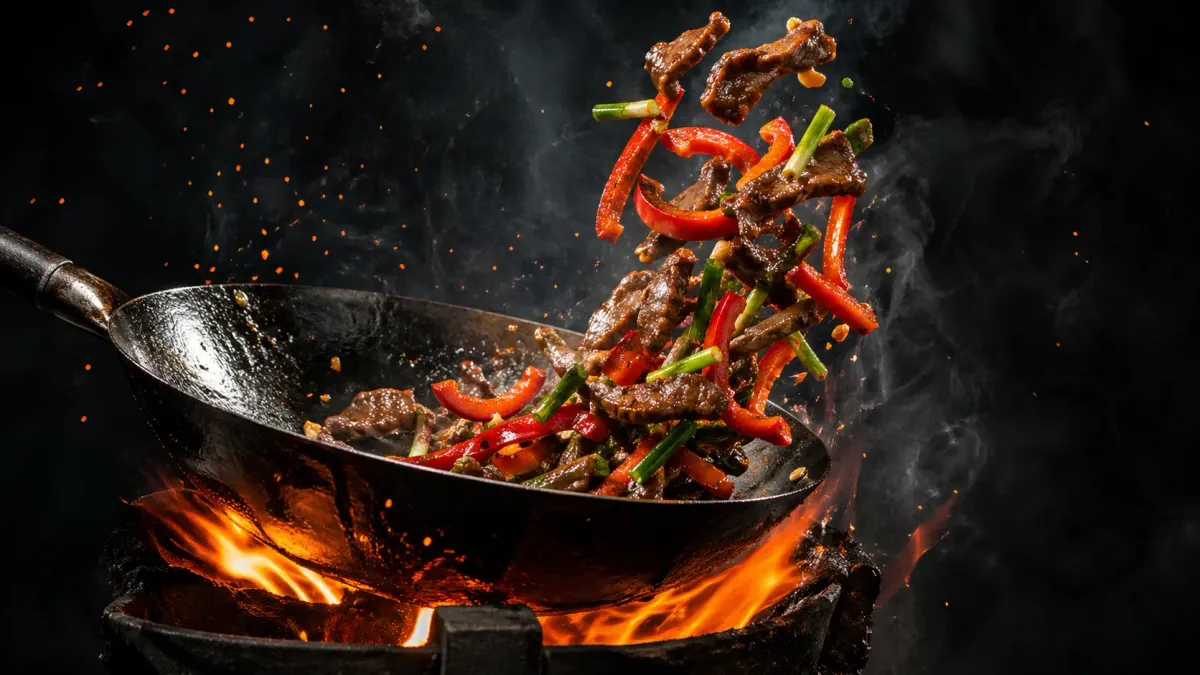
Category wok
What This Page Solves
This is not gear collecting. It is a translation of physical cooking constraints into flavor outcomes: heat, smoke, texture, and why some tools unlock them while others block them.
A $30 carbon steel wok will make better Chinese food than a $200 nonstick pan. I know this because I've owned both, cooked on both, and ruined food on both. The carbon steel wok beats the nonstick on heat control, wok hei potential, durability, and the specific kind of sear that makes stir-fried food taste like it came from a restaurant. The nonstick beats the carbon steel on exactly one thing: it doesn't require seasoning. Everything else, the $30 wok wins.
Seasoning a carbon steel wok is not difficult. It's tedious and your kitchen will fill with smoke, but it's not difficult. I failed at it three times before I figured out the right oil, the right temperature, and the right amount of patience. The first time, I used olive oil (smoke point too low — burned immediately). The second time, I used too much oil (created a sticky, gummy residue that took an hour to scrub off). The third time, I didn't heat the wok long enough before adding the oil (the oil pooled and polymerized unevenly, creating a patchy surface that stuck in some spots and released in others). I learned more from those three failures than from any YouTube tutorial.
You cannot season a carbon steel wok on an induction cooktop the same way you would on gas. Induction heats the bottom of the wok only — a flat disc of heat about 15cm in diameter. The sides remain cold. On gas, the flame wraps around the wok and heats the sides too. This means seasoning on induction is a multi-step process: you heat one section at a time, tilting the wok to expose different areas to the burner. It takes about 20 minutes instead of 5. It works. It's annoying. I've done it. You can too.
I bought my first carbon steel wok in 2022 from a kitchen supply shop on Shanghai Street in Yau Ma Tei, Hong Kong. It cost $68 HKD — about $9 USD at the time. It was a flat-bottom 34cm model with a single long wooden handle and a rough, grey surface that felt almost like sandpaper. The shopkeeper told me three things: "Wash it with soap and a steel scrubber to remove the factory coating. Then heat it. Then oil it. Then heat it again." I nodded, paid, and went home to ruin my first wok.
The Seasoning Protocol That Finally Worked (After Three Failures)
Here is exactly what I do now, written for induction users specifically because that's what I cook on. If you have gas, it's easier — skip the tilting steps and just heat the whole wok evenly.
Step 1: Scrub the factory coating off. New carbon steel woks come with a protective coating — usually wax, sometimes oil, sometimes something unidentifiable — that prevents rust during shipping. You must remove this completely. Hot water, dish soap, and a stainless steel scrubber. Scrub until the wok feels uniformly rough and the water runs clear. This takes about 5 minutes. It's the least fun part of the process. Do it thoroughly. Residual coating will prevent the seasoning from bonding.
Step 2: Dry the wok over heat. Put the wok on the burner at medium heat (setting 6 on my induction). Let the residual water evaporate. You'll see the surface change color — from wet grey to dry grey to a slightly lighter, warmer grey. When there are no water droplets left and the metal feels warm to a hovering hand, move to step 3.
Step 3: Apply the thinnest possible layer of oil. Pour about 1/2 teaspoon of oil — I use peanut oil because its smoke point is high (230°C) — onto a paper towel. Wipe the entire inner surface of the wok. Then — and this is the trick that took me three failures to learn — take a clean, dry paper towel and wipe the oil off. You're not trying to leave visible oil. You're trying to leave a molecular-thin film. The wok should look dry but slightly glossy. If you can see oil pooling or streaking, you used too much. Wipe again.
Step 4: Heat until smoking. Crank the heat to maximum (setting 9 on my induction). The wok will start to smoke — thin, wispy trails at first, then a steady stream. This is the oil polymerizing — the fatty acids are breaking down and bonding to the metal surface at a molecular level. On induction, you'll need to tilt the wok to heat the sides. Focus on one section at a time: heat the bottom until it darkens, then tilt to heat the left side, then the right side, then the front, then the back. Each section takes about 2-3 minutes at maximum heat to darken. The color should go from silver-grey to brown to dark brown to blackish. If it goes grey or ashy, you burned the oil — the heat was too high for too long in one spot. Scrub that section and restart.
Step 5: Cool and repeat. Turn off the heat. Let the wok cool until you can touch it comfortably — about 10 minutes. Apply another molecular-thin layer of oil. Heat until smoking again. Repeat this cycle three times total for the initial seasoning. The wok will be unevenly colored — splotchy brown and black patches, maybe some blue streaks. This is normal. It will even out with use.
Step 6: Cook something fatty for the maiden voyage. The first dish in a newly seasoned wok should be something that releases fat as it cooks — stir-fried pork belly, fried eggs, anything with natural oils. The fat from the food will add to the seasoning layer. Avoid acidic foods (tomatoes, vinegar-based sauces) for the first 3-5 cooks — acid degrades the young seasoning.
The whole process takes about 40 minutes on induction. On gas, about 15. It's worth it. A properly seasoned carbon steel wok is naturally nonstick in a way that improves with every cook. My wok, seasoned over about 200 meals now, releases fried eggs more cleanly than any nonstick pan I've ever owned — and unlike nonstick, it will never wear out or release coating particles into my food.
The Induction Problem — and How I Cook Around It
Induction cooktops have two fundamental problems for wok cooking:
Problem 1: Heat only at the bottom. Induction creates heat through magnetic induction — only the area in direct contact with the cooktop surface gets hot. For a flat-bottom wok, that's a circle about 15cm in diameter. The sides of the wok receive almost no direct heat. On gas, the flame wraps around the wok and heats the sides to within 50-100°C of the bottom temperature. This matters because the sides of the wok are where you push food to keep it warm while you cook the next batch. On induction, the sides are essentially a resting area, not a cooking surface.
Problem 2: Pulsing heat. Induction burners deliver heat in pulses — especially below maximum power. My cooktop cycles on and off in approximately 3-second intervals at settings below 9. This means the wok temperature oscillates: hot, less hot, hot, less hot. For tasks requiring steady heat — like maintaining an oil temperature for deep frying — this is a genuine issue. The fix: use a heavy-bottomed wok (thicker steel has more thermal mass and smooths out the temperature oscillations) and preheat longer (the extra thermal mass takes longer to heat but holds temperature more steadily).
What I've learned: wok hei on induction is possible but limited. You can get the searing, the browning, the smoky edges. You cannot get the airborne flame contact that defines professional wok hei — the oil droplets that leap above the wok and ignite. For that, you need gas. I now keep a portable butane burner ($88 HKD) for weekend stir-fries and use my induction for everything else. The butane burner produces noticeably better results. It's not practical for Tuesday night dinner. It's worth the setup time for dishes where you care.
Cleaning and Maintenance
Never use soap on a seasoned wok. Soap strips the seasoning. Instead, rinse the wok while it's still warm (not hot — you don't want to shock the metal) under hot water. Scrub with a bamboo wok brush — a bundle of thin bamboo splinters tied together, $12 HKD at any kitchen supply store — or a non-abrasive sponge. If food is stuck, add a splash of water to the warm wok and let it deglaze for 30 seconds. The stuck bits will release.
Always dry the wok after washing. This is the most important maintenance rule and the one I violated most often in my first year of wok ownership. Carbon steel rusts. A wet wok left in a dish rack will have visible rust spots within 2-3 hours — earlier in humid Hong Kong summers. After washing, put the wok back on the burner at low heat for 60 seconds to evaporate every trace of moisture. Then wipe with a paper towel containing a tiny amount of oil — just enough to create a protective film. The wok should look dry and slightly glossy, not oily.
If it rusts, don't panic. Scrub the rust off with steel wool until you see bare metal. Wash with soap to remove any residual rust particles. Re-season that section. It takes about 10 minutes. I've done this three times over four years — each time because I forgot to dry the wok after washing. The wok survived. The seasoning layer is renewable. Carbon steel is nearly indestructible as long as you don't let rust penetrate deeply.
Common Mistakes
Using too much oil when seasoning. The number one mistake. A thick layer of oil polymerizes into a sticky, gummy residue that food will stick to. You want the thinnest possible layer — wipe it on, then wipe it off with a clean towel. The film should be barely visible.
Not heating the pan enough before adding food. A wok is ready when a drop of water skitters across the surface and evaporates in under one second. If the water just sits there and bubbles, the wok is too cold. Food added to a cold wok will stick, release water, and steam instead of sear.
Using metal utensils improperly. A metal spatula is essential for wok cooking — you need the thin edge to get under food and flip it cleanly. But aggressive scraping, especially on a young seasoning layer, will scratch through the seasoning to bare metal. Use the spatula to lift and flip, not to scrape. Let the food release naturally — if it's sticking, it's not ready to flip.
FAQ
Q: What's the best wok for an induction cooktop? Flat-bottom carbon steel, 34-36cm diameter, with a single long handle. The flat bottom maximizes contact with the induction surface. The single handle allows tossing. In Hong Kong, generic brands from kitchen supply shops run $60-100 HKD. In the US, the Craft Wok Traditional Hand-Hammered ($60 on Amazon) is the most commonly recommended entry-level option.
Q: Can I use a round-bottom wok on induction? No. The round bottom makes contact only at a single point. The heat transfer is essentially zero. You need a wok ring (metal stand that holds a round wok above the burner), but with induction, there's no flame to heat the air inside the ring. The wok stays cold. Use flat-bottom only.
Q: How do I know if my seasoning is ready? Fry an egg. If it releases cleanly with minimal sticking, your seasoning is good. If it sticks and tears, the seasoning needs more layers or the pan wasn't hot enough when you added the egg.
理论基础 / The Science Behind It
The wok's sloping sides and thin carbon steel are optimized for heat transfer and tossing. Seasoning is polymer chemistry.
Continue Exploring
Written by Mike Sang
Digital strategist, fermentation science enthusiast, and student of the Tao. Bridging growth engineering with ancient Chinese food wisdom.
Seasonal Context
Flavor changes with the season. Your cooking should too.
Missing Umami is part of The Way of Nature, a living system connecting food, timing, and seasonal practice.