Editorial Guide
Velveting 101 — The Technique That Makes Chinese Restaurant Meat So Tender
Velveting is a 30-second pre-cooking step that transforms tough, lean meat into the silky, tender protein you get at restaurants. Here's exactly how it works and how to do it at home.
Type Editorial Guide
Linked Ingredients 2
Next Steps 2
Velveting is the single technique with the highest impact-to-effort ratio in Chinese cooking. It takes about five minutes of active work and transforms the texture of lean meat from "good home cooking" to "restaurant-quality." I've velveted every piece of chicken, pork, and beef I've stir-fried since I learned the technique, and the difference is so dramatic that I can't believe I ever stir-fried without it.
This page is the general reference: what velveting does, which starch to use, what ratios hold up, how to blanch, and what to do when it goes wrong. If you want the chicken-specific playbook — the baking soda versus egg white face-off, slicing for a breast versus a thigh, and the substitute table — go straight to the Velveting Chicken Guide.
Velveting Is Not Marinating
Marinating adds flavor to the surface of meat. Velveting creates a physical coating — a microscopically thin layer of egg white and starch — that seals the surface, prevents moisture loss during cooking, and produces a silky texture that persists even if you slightly overcook the meat.
A marinated chicken breast will still be dry if you cook it 90 seconds too long. A velveted chicken breast will be tender even with a 60-second timing error. The coating buys you a margin of error, which is exactly what home cooking lacks.
The distinction matters when you plan a dish. Marinades season. Velveting changes physics. You can marinate a pork loin for a whole afternoon and it will still be tough if you seared it past medium. You can velvete it for ten minutes and it will stay tender through a hard sear.
The Science: Two Coatings, Two Temperatures
The coating is a protein-starch matrix, and the useful part is that its two components set at different times and different temperatures than the meat does.
Egg white proteins begin to denature somewhere around 60°C and set mostly by 80°C. Cornstarch gelatinizes in the low-to-mid 70s. Both are well below the temperature where the centre of a thick piece of meat has cooked through. So when you drop velveted meat into a hot wok, the coating sets first — while the inside is still raw and still holding its water.
Three things follow from that:
The barrier works. The set coating reduces how much water can migrate out of the muscle during cooking. That is the entire mechanism, and it is why velveting helps most on lean cuts that have little internal fat to lose: chicken breast, pork loin, tenderloin, flank steak.
The surface browns better. A raw meat surface sears unevenly because moisture keeps evaporating unevenly. A set starch coating gives the oil something dry to contact, so the Maillard reaction gets to start sooner and more consistently. That is where a good deal of the "restaurant" flavour in a stir-fry comes from.
Timing tolerance goes up. Because the interior is protected, pushing the cook time by thirty seconds costs you less than it would on bare meat.
The same cornstarch logic applied to liquid instead of meat is the Starch Slurry Guide. Velveting and slurry thickening are the same physics pointed at two different problems.
Choosing Your Starch
This is where most home recipes go wrong, because they say "cornstarch" and mean one specific behaviour. The starches are not interchangeable.
Cornstarch is the default and the right answer most of the time. It sets opaque and holds a visible coating, which is what you want when the meat is going into a hot wok and you want to see that it is coated. It also has the highest thickening power of the common kitchen starches, which is why it is what Chinese cooking reaches for by default.
Potato starch sets glossier and more translucent, and forms a slightly softer gel. Restaurant cooks sometimes use it for texture rather than for the barrier effect. If your aim is a shinier surface on a light-coloured sauce, it is worth trying.
Tapioca starch is the most forgiving. It tolerates longer resting times without becoming gummy, which matters if you are velveting ahead for a dinner party.
Rice flour or cornstarch substitutes you have never tested are not interchangeable with cornstarch in a 1:1 swap. Ask for cornstarch specifically, or ask what starch the dish was written for.
One warning: do not use cornflour that is blended with wheat flour. In Britain and parts of Europe, "cornflour" means what North America calls corn starch, and blending it with wheat changes both the setting temperature and the result.
Ratios That Actually Hold Up
The ratios that circulate online are usually given per piece of meat, which is useless, because a chicken breast and a slab of flank steak are not the same problem. Measure by weight instead.
For about 450g of sliced lean meat, the coating that consistently works for me:
| Component | Amount | Why it is there |
|---|---|---|
| Egg white | 1 large, separated | The protein that sets first and forms the structure |
| Cornstarch | 1.5 tablespoons | The body of the coating and the barrier |
| Shaoxing wine | 1 teaspoon | Loosens the proteins and removes any gaminess |
| Light soy sauce | 1 teaspoon | Seasoning and a little extra salt |
| Oil | 1 teaspoon | Stops the meat from seaming together when you toss it |
The ratio to scale is roughly 1 egg white plus 1 tablespoon of starch per 300g of meat. Going heavier on starch produces a noticeably crispier, almost battered exterior. Going heavier on egg white produces a more fragile, more translucent glaze. Both are legitimate; they are just different techniques.
If you want to skip the egg, use 1.5 tablespoons of cornstarch, 1 tablespoon of oil and 1 teaspoon of wine per 450g. The coating is thinner and less protective, and it still beats no velveting by a wide margin. I use this version for anyone with an egg allergy.
The Two Blanching Methods
The coating is only half the technique. The second half is a brief blanch that sets the coating before the meat hits the wok.
Water blanching, my default. The velveted meat goes into gently simmering water for 30 to 45 seconds, until the exterior turns opaque. It needs no special equipment, uses no additional oil, and the water can be saved as a light stock. This is the method for roughly 95% of my home cooking, and it produces what I consider restaurant-quality results.
Oil blanching, 滑油 (huá yóu), the restaurant method. The meat goes into oil held at roughly 120 to 140°C — well below smoking, well below browning — for 30 to 60 seconds. The result is richer and glossier. It costs about two cups of oil, which you can strain and reuse, so I only do it when I am cooking several dishes at once and the investment pays for itself.
There is a third variant worth knowing: many restaurants blanch in water with aromatics — a few slices of ginger and a scallion — which costs nothing and seasons the meat slightly during the set. I use this most weeks.
I tested the two side by side in January 2025: two identical chicken breasts, velveted identically, one through oil and one through water, then stir-fried in identical woks with identical sauce. In a blind taste test my wife correctly picked the oil-velveted one as "slightly richer", but called both "clearly restaurant-quality." Water wins on convenience, oil wins on richness, and both beat un-velveted by a margin no sauce can close.
Which Protein, Which Approach
Not every protein wants the same treatment. This is the quick reference; the reasoning is above.
| Protein | Best approach | Notes |
|---|---|---|
| Chicken breast | Velvete with egg white + cornstarch | The clearest case for the technique. Almost no internal fat, and it is the cut most often overcooked. |
| Pork loin or tenderloin | Velvete with egg white + cornstarch | Same logic as chicken. Slice thin against the grain. |
| Flank steak | Slice thin, velvete briefly, sear hard and fast | The starch is less important than the thin slicing and the short sear. |
| Beef tenderloin | Marinate is usually enough | Already tender. A light coating is harmless but unnecessary. |
| Pork belly or fatty cuts | No coating | The coating reads as gummy on fat. Slice and render instead. |
| Brisket, short ribs, tendon | Braise | Velveting is the wrong tool entirely. These need hours, not seconds. |
| Fish | Cornstarch slurry for crispness | Muscle is already short-fibrred; a coating turns pasty. |
| Shrimp | Dry brine or a light cornstarch dust | Overcooks in seconds. Protect the texture, do not build a barrier. |
What Velveting Does Not Fix
Being clear about the limits saves more effort than the technique gains.
It does not fix the wrong cut. Velveting makes lean meat tender. It does not make a badly cut piece of meat good, and it will not rescue meat that has been over-tenderized by an hour in an alkaline marinade.
It does not make tough cuts tender. Tendon and heavily worked muscle are a different problem. Brisket and short ribs want long braising, not a coating.
It does not survive a very long cook. The barrier holds for the minutes a stir-fry needs. It is not a strategy for a two-hour braise, where the coating simply dissolves.
It does not replace salting. A velveted piece of meat still needs salt. The coating holds water in, it does not season the interior.
It does not work well on fatty or already-tender cuts. A marbled pork belly or a well-aged tenderloin does not need it, and the coating can read as gummy on fatty surfaces.
The Basic Velveting Protocol
For one chicken breast, or any 450g of sliced lean meat:
- Slice the meat against the grain into thin, uniform pieces, about 3 to 5mm thick. Uniformity matters more than thickness — pieces of different sizes cook at different rates and the thin ones overcook before the thick ones finish.
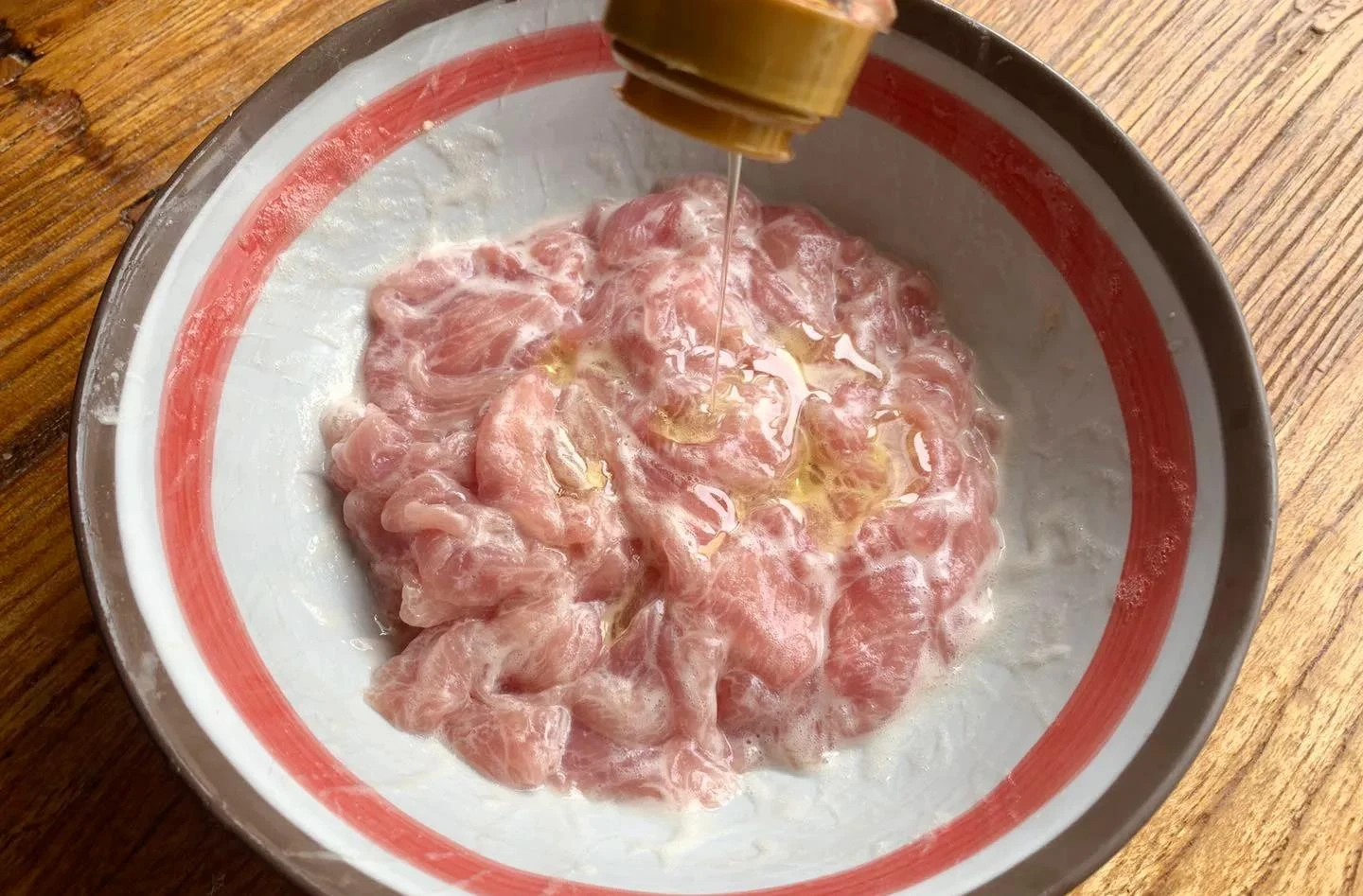
- Mix 1 egg white, 1.5 tablespoons cornstarch, 1 teaspoon Shaoxing wine, 1 teaspoon light soy sauce and 1 teaspoon oil in a bowl until smooth.
- Add the meat and massage it with your hands for about 30 seconds. The mechanical action genuinely helps the coating adhere; skipping it is the most common reason a coating slides off in the wok.
- Rest for 10 to 15 minutes at room temperature.
- Pass through gently simmering water, or oil at 120 to 140°C, for 30 to 45 seconds until the exterior turns opaque.
- Drain thoroughly and stir-fry immediately.
Total time including rest is about 20 minutes, of which perhaps five are active. The reward is meat that comes out tender and silky every single time.
Troubleshooting
The coating fell off in the wok. Almost always one of three things. You did not massage the meat long enough. The slices were too thick or too ragged to hold a layer. Or you blanched too long and pushed the coating past set into something brittle. Work through those in that order.
The meat is slimy or gummy. The coating was too thick for the cut, or the meat sat after blanching. Once the coating has set, it keeps absorbing. If you are blanched early, fry within fifteen minutes or blanch later instead.
The meat turned dry anyway. Usually a size problem. Thick pieces have too much thermal mass to be velveted, and the centre overcooks before the surface barrier has done its work. Cut thinner, or use a different technique.
It turned out chewy rather than tender. You probably used a cut better suited to braising, or you skipped the rest period, which is when the salt and starch actually work into the surface.
The coating is too thick to see the meat. Reduce the starch, not the rest time. Time affects flavour penetration; starch quantity affects thickness.
FAQ
Q: Can I velvet without egg white? Yes. Use 1.5 tablespoons of cornstarch plus 1 tablespoon of oil and 1 teaspoon of Shaoxing wine per 450g of meat. The coating is thinner and less protective, and still dramatically better than nothing. This is my version for anyone with an egg allergy, and the version I use when I cannot be bothered to separate an egg.
Q: Can I velvet in advance? Yes, up to four hours. Velvet the meat, cover, and refrigerate. Blanch in water or oil immediately before cooking. Do not blanch in advance — a set coating kept warm for an hour turns gummy.
Q: Does velveting work for beef and pork? Yes, the same protocol applies. Beef arguably benefits more than chicken, because its coarser muscle structure loses water faster under high heat. For very lean beef a teaspoon of baking soda dissolved in the water works alongside starch, though that is a pH change rather than a barrier — the chicken guide covers the tradeoffs.
Q: Is cornstarch or potato starch better? Cornstarch for an opaque barrier you can see. Potato starch for a glossier, more translucent result, which matters more when the meat goes into a light sauce. Tapioca if you are velveting hours ahead and want the coating to survive the wait.
Q: Can I skip the blanching step? You can, and the meat will still be more tender than un-velveted. What you lose is the set barrier, which means less tolerance for overcooking and less even browning. The blanch is what converts velveting from "slightly better" to "reliably restaurant."
Q: How long should the coating rest before cooking? Ten to fifteen minutes at room temperature. Cold rest works but takes longer, and past about an hour the coating starts to relax.
Q: Does velveting work on fish? Not the way it does on meat. Fish muscle is already short-fibrred and delicate, so the coating mostly adds weight and can turn the surface pasty. Fish is usually treated with a cornstarch slurry for crispness instead, which is a different technique.
Q: What does 滑鸡 (huájī) mean on a menu? It means "slippery chicken" and it is exactly this technique — chicken that has been coated and blanched so it stays tender. If you see it on a menu and the chicken is dry, they skipped something.
理论基础 / The Science Behind It
Velveting uses egg white and starch to create a protein-starch matrix that denatures and gelatinizes well below the temperature at which the meat's interior cooks through. That timing difference is what produces the barrier: the surface seals first, while the centre is still holding its water.
The same starch chemistry that thickens a sauce — see Starch Slurry Guide — is doing the work here. Starch gelatinization is covered in more depth in The Geography of Chinese Flavor, which explains why Chinese kitchens treat starch as a structural ingredient rather than a thickener.
Continue Exploring
Written by Mike Sang
Digital strategist, fermentation science enthusiast, and student of the Tao. Bridging growth engineering with ancient Chinese food wisdom.
Seasonal Context
Flavor changes with the season. Your cooking should too.
Missing Umami is part of The Way of Nature, a living system connecting food, timing, and seasonal practice.