Umami Science
What Is MSG? The White Crystal That Makes Food Taste Alive
MSG is the flavor of your grandmother's stock, crystallized into a white powder — and the fear around it began with a 1968 letter, not a study. What MSG is, what it isn't, and how to use it.
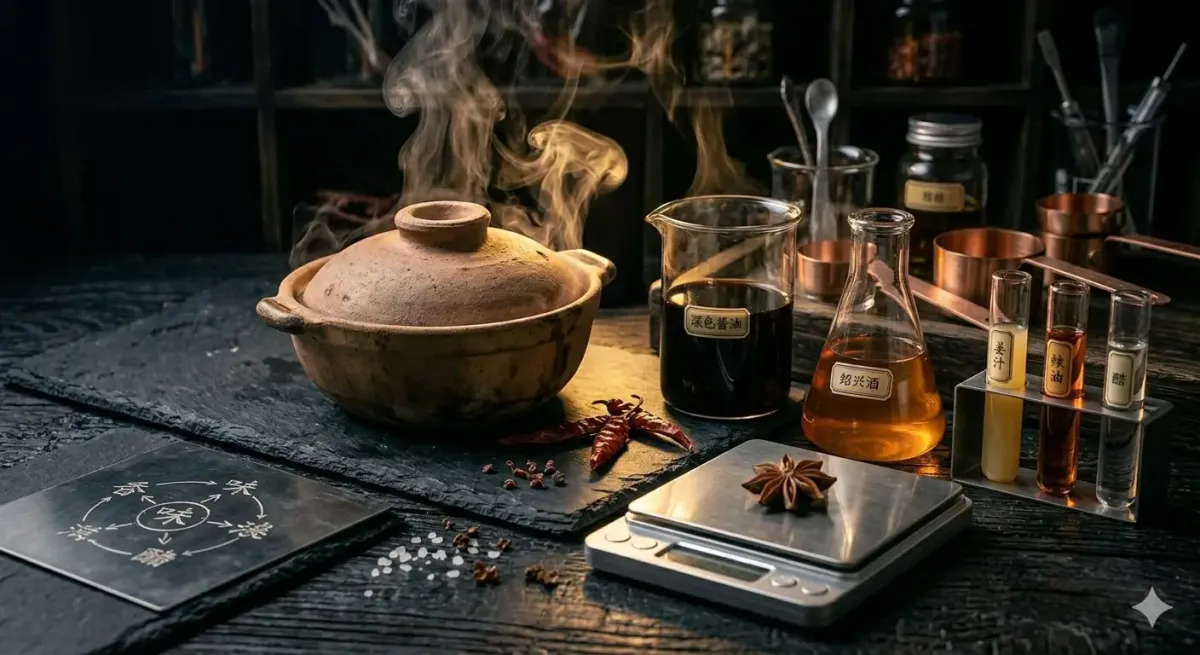
Topic Flavor Science
Linked Ingredients 4
Related Reads 4
Working Rule
If a dish is properly salted but still tastes flat, you likely have a missing umami problem, not a seasoning problem. This page exists to help you see that difference clearly.
The Small White Jar
It sits next to the salt, a squat white jar with a red cap, the Ajinomoto label worn at the edges from a decade of fingertips. In the Hong Kong kitchen where I grew up, it was as unremarkable as the rice cooker — one of the three mothers of every stir-fry, alongside the wok and the soy sauce bottle. Nobody blinked at it. Nobody called it dangerous. It was simply 味精, wèijīng, the essence of flavor, and it made the food taste alive.
Then I went west, and discovered, with genuine bewilderment, that the same white crystal had a reputation. Grown adults whispered about it the way they whispered about additives in cheap candy. There was a diagnosis attached to eating Chinese food — Chinese Restaurant Syndrome — as if my grandmother's cooking were a medical event waiting to happen. It took me years to untangle the knot, and the answer turned out to be embarrassingly simple: the fear was a story, told in a letter to a medical journal in 1968, repeated ever since, and never once backed by a study. Not a study. A letter.
The molecule in that jar is the same molecule that occurs in Parmesan, in tomatoes, in soy sauce, in your own body. The flavor of your grandmother's stock, crystallized into a white powder — the fear was a 1968 letter, not a study. When I finally understood that, I stopped treating MSG as a guilty pleasure and started treating it as what it is: one of the most precise, cheap, and honest flavor tools a cook can own.
What Is MSG, Exactly?
MSG — monosodium glutamate, E621 — is the sodium salt of glutamic acid, an amino acid found naturally in almost everything that tastes savory. It presents as a white crystalline powder with no aroma and only a faint saltiness of its own. When it dissolves on your tongue, it separates into sodium ions and free glutamate, and that free glutamate is what your taste buds detect as umami — the fifth basic taste, the deep, mouth-filling savoriness that makes food feel substantial and satisfying rather than merely salted. In plain terms: MSG is the purified, crystallized version of the flavor molecule your tongue is already wired to celebrate. It is not a flavor itself, but a signal amplifier — a way of telling your brain that this food is nutritious, protein-rich, worth eating. It is produced today by fermentation, a process closer to brewing beer than to any sinister laboratory synthesis. And it has been eaten, in one form or another, for as long as humans have fermented food.
What It's Made Of — Chemistry Without the Fear
Every protein in your body is assembled from amino acids, and glutamic acid is the most abundant of them. It is not a rare synthetic oddity; it is the molecular backbone of life. When you eat a ripe tomato, you take in around 246 milligrams of glutamate per 100 grams. A wedge of Parmesan delivers over 1,200 milligrams per 100 grams. Soy sauce carries roughly 800 milligrams per 100 milliliters. Breast milk is rich in it, for a very good reason: the taste of glutamate is the taste of nourishment itself, and infants are born with the receptors to recognize it.
So when someone calls MSG a "chemical," the word is doing no work. Everything is a chemical. Your grandmother's stock is a chemical. The fear never rested on the molecule — it rested on the word "synthesized," on a white powder that looked like laboratory salt rather than like food. But here is the fact that ends the argument: once MSG dissolves, your body cannot distinguish its glutamate from the glutamate in a tomato or a piece of chicken. Same molecule. Same receptor. Same signal. The white crystal is not a foreign agent; it is the familiar flavor of protein, isolated and stabilized so it can wait patiently in a jar until you need it.
Where It Comes From — Ikeda, Kombu, and the Older Chinese Story
The famous origin story is Japanese, and it is a good one. In 1908, a chemistry professor named Kikunae Ikeda was eating a bowl of dashi and asked himself a question that most people would simply enjoy and forget: what is responsible for this flavor? He spent months boiling down thirty-eight kilograms of kombu — the thick, leathery kelp at the heart of Japanese broth — evaporating, crystallizing, purifying, until he held a single crystal of something that tasted like neither sweet, nor sour, nor salty, nor bitter. It tasted like the soup. He called the taste umami and the substance glutamic acid, and in 1909 the Ajinomoto company began selling it as the world's first synthetic seasoning. The rest, as they say, is history — the naming of a taste, the founding of an industry, the birth of the white crystal.
But the Chinese story is older and less told. For millennia, Chinese cooks had been engineering concentrated glutamate without any knowledge of chemistry. Soy sauce is a fermented slurry of soybeans and wheat whose enzymes chew proteins into free amino acids — enormous amounts of glutamate, released by enzymatic hydrolysis. Doubanjiang ferments broad beans into a dark, funky savory paste. Fish sauce extracts glutamate from anchovies using only sun, salt, and time. Dried shrimp are tiny flavor bombs of it. And the aesthetic vocabulary for all of it — 鲜, xiān, that clean, savory freshness of good broth — is an ancient Chinese culinary concept, centuries older than Ikeda's coinage of "umami."
When the white crystals arrived in Chinese kitchens in the early twentieth century, they were adopted with astonishing speed. Not because Chinese cooks were seduced by something foreign, but because the jar contained something they already knew intimately: the flavor of every fermented thing they had cooked with since childhood, purified and made instant. That is why the Chinese name for it is 味精, wèijīng — essence of flavor — and why it sits on Chinese pantry shelves next to salt, as an ordinary staple rather than a suspicious additive. The fear of MSG, in other words, is not a Chinese story. It is a Western one.
Why It Works — Receptors, Nucleotides, and Synergy Math
The reason MSG works is now understood at the molecular level, and it is genuinely beautiful. Your tongue carries dedicated glutamate receptors — the T1R1-T1R3 complex and a family of related sensors — that fire specifically in the presence of free glutamate. That is the hard evidence that umami is a real, basic taste, not a marketing invention. But the receptors have a secret: they respond dramatically better when certain nucleotides are present alongside the glutamate. Inosinate (IMP), found in dried fish, bonito flakes, and meat, and guanylate (GMP), found in mushrooms — especially dried shiitake — synergize with glutamate. Together, the combination registers many times more intense savory flavor than the sum of its parts. Some estimates put the amplification at eightfold or more.
This is the chemistry behind the world's most proven food pairings. Dashi is kombu (glutamate) and bonito flakes (inosinate) in a single bowl. Tomato and Parmesan is glutamate meeting glutamate — and tomato with anchovy is glutamate meeting inosinate, which is why that pairing sings. Chinese cooks have been doing this synergy math for centuries without writing the equation: light soy sauce with a splash of fish sauce, oyster sauce over shiitake mushrooms, a pinch of the white crystal over long-cooked stock. The technique has a name now — umami-stacking — but the practice is ancient. MSG just collapses the entire equation into a small white jar.
What MSG Is Not — the Letter That Started Everything
Now the uncomfortable part of the story. In 1968, a physician named Ho Man Kwok wrote a short letter to the New England Journal of Medicine describing numbness and palpitations he experienced after eating at Chinese restaurants, and speculated — in a single speculative paragraph, based on a single anecdote — that monosodium glutamate might be the cause. It was a letter to the editor. Not a study. Not a trial. Not peer-reviewed data. No one had tested anything. But the letter gave a label to a vague anxiety — "Chinese Restaurant Syndrome" — and the label stuck like a burr.
Fifty years of research followed, and the symptoms were never reliably reproduced in controlled studies. People who believed they were sensitive could not consistently tell apart MSG-laced food from identical food without it. Regulatory agencies around the world — the U.S. FDA, the European Food Safety Authority, the WHO's Joint Expert Committee on Food Additives — all reviewed the evidence and classified MSG as safe for the general population. The label itself has been steadily walked back: in 1995, an expert panel for the Federation of American Societies for Experimental Biology recommended replacing "Chinese Restaurant Syndrome" with the more clinical "MSG symptom complex," and in 2020, after a petition from Ajinomoto, Merriam-Webster revised its dictionary entry, flagging the term as dated and offensive — an acknowledgment of what it always was: a racialized panic attached to a molecule. The irony is that the same glutamates were in the soy sauce, the dried shrimp, the fermented vegetables of that meal — the white crystal was never the only source. The fear was a story. The science came later, and the science did not agree.
Regulatory verdict at a glance
| Authority | Position on MSG |
|---|---|
| U.S. FDA | GRAS (Generally Recognized As Safe) |
| EFSA (EU) | Approved food additive (E621) |
| WHO/JECFA | Safe for general population; no ADI limit required |
The full story of how a single 1968 letter outran 50 years of evidence — including my own blind-test dinner party — is in MSG Myths.
How to Use It — Four Moves, One Ceiling
MSG is a precision instrument, not a dust storm to be unleashed over everything. The rule I keep coming back to, the one that has yet to fail me: reach for it when a dish tastes flat but correctly salted. Flat is the key word. If a stir-fry is perfectly seasoned, perfectly balanced, and yet somehow hollow — the flavor is sitting in the front of your mouth and not blooming outward — that hollowness is missing free glutamate.
Four moves cover ninety percent of home use. First, stir-fry finishing: one-eighth of a teaspoon per two servings, added with the light soy sauce at the end so it dissolves into the liquid and coats the food evenly. Second, soups: a tiny pinch at the end, off the heat, so the crystal dissolves without cooking away — it doesn't actually cook away, but adding it late keeps you from overshooting. Third, marinades: a quarter-teaspoon per pound of meat, dissolved into the soy, wine, and cornstarch mix, where it works its way into the muscle fibers alongside the salt. Fourth, vegetables: a thumb-and-forefinger pinch scattered over sautéed greens as they come out of the wok, where it brightens the flavor of the vegetables without making them taste seasoned.
The ceiling is real, and respecting it is the difference between a cook and a chemist with a grudge. Around half a teaspoon per serving, the molecule flips from "alive" to "metallic" — a flat, sharp, almost saline edge that ruins the dish. That is the signal of overshoot. Back off. The salt-replacement math is worth knowing too: MSG carries about one-third the sodium of salt by weight, so swapping roughly half of your salt for a smaller amount of MSG can cut a dish's sodium by around thirty percent without losing saltiness — in fact, the MSG carries the remaining salt deeper into the palate, so it can taste saltier while containing less sodium. That is not chemistry at war with health. That is chemistry helping.
Quick use reference
Working rule: reach for it when a dish tastes flat but correctly salted.
| Move | Amount | When to add |
|---|---|---|
| Stir-fry finishing | 1/8 tsp per 2 servings | with the light soy sauce, at the end |
| Soups | a tiny pinch | off the heat, at the end |
| Marinades | 1/4 tsp per lb of meat | dissolved into the soy/wine/cornstarch mix |
| Vegetables | a thumb-and-forefinger pinch | as greens come out of the wok |
| ⚠ Overshoot ceiling | ~1/2 tsp per serving → metallic edge | if you hit it, back off |
| Salt swap | ~half the salt → less MSG | cuts sodium ~30%, tastes saltier |
Why Restaurant Chinese Food Tastes Different
Every home cook who has tried to replicate Chinese takeout has asked this question. Part of the answer is wok hei — 镬气, the breath of a wok — that complex smoky-roasted flavor that only a jet-engine burner and a screaming-hot seasoned steel surface can produce, the volatile compounds of oil, soy, and garlic seared into existence in seconds. Home stoves cannot reach those temperatures, full stop.
But the rest of the answer is embarrassingly visible if you look behind the counter of a serious Cantonese kitchen: a row of white jars, in the open, next to the salt and sugar. MSG, chicken powder, a scoop in every stock, a pinch in every sauce. Restaurant cooking does not fear umami. It stacks it: stock made from bones (glutamate and inosinate), dried shrimp in the broth (more glutamate), oyster sauce spooned in at the finish (a fermented concentrate of yet more glutamate), and the white crystal as a guarantee — the baseline that ensures the flavor survives the wok's brutal heat and the full-frontal assault of a roomful of diners. The difference between restaurant Chinese food and home Chinese food is not access to a secret chemical. It is the willingness to use every tool in the umami arsenal, the white jar among them, without apology.
Common Mistakes — 翻车 Cases
Let me confess my own 翻车 — kitchen wrecks — so you can skip them. The most common failure is overshoot: adding MSG like it is salt, and discovering the flat, metallic edge that signals the ceiling has been breached. The fix is always the same — measure, taste, back off. The white crystal rewards precision and punishes enthusiasm.
The second mistake is stacking on a stack. If a dish already has light soy sauce, oyster sauce, shiitake mushrooms, and fish sauce in it, you are already standing on a mountain of glutamate. Adding MSG to that will not lift it — it will flatten the top by overloading the receptors. Skip it. The third mistake is treating MSG as a 1:1 salt substitute. It is not salt. It does not make things salty; it amplifies the salt you already have. Use it as salt's partner, not its replacement.
The fourth mistake is brand loyalty of the expensive kind: buying Accent at a markup when it is literally the same molecule — pure monosodium glutamate — as any generic brand or the Ajinomoto jar at the Asian grocer. Read the label. If it contains one ingredient and that ingredient is monosodium glutamate, you are buying the same crystal. And the fifth mistake is confusing MSG with chicken powder. Chicken bouillon powder often contains MSG, but it also contains chicken fat, salt, sugar, and herbs — it is a seasoning blend, a different instrument with a different function. The white jar is a soloist. Chicken powder is the ensemble.
Buying the Crystal — Brands, Labels, Prices
Ajinomoto, the original red-capped jar, is still the company Kikunae Ikeda founded, and across Asia it is sold on every corner, in every size from single-serving sachet to family tub. In the United States, the same crystal hides under the brand name Accent, and countless generics. They are all identical — monosodium glutamate, nothing else — so buy on price and convenience.
When reading labels, know the aliases. Pure MSG is labeled monosodium glutamate or E621. But the same family of molecules appears under other names: hydrolyzed protein, autolyzed yeast extract, yeast extract, disodium inosinate, disodium guanylate. These are not contaminants; they are the same glutamates and nucleotides doing the same work. If you are trying to avoid glutamate, you would have to avoid Parmesan, tomatoes, soy sauce, and breast milk — a diet that would be neither possible nor wise.
Price reality: a bag of Ajinomoto from an Asian grocery runs roughly twelve Hong Kong dollars per hundred grams — about a dollar and a half — and lasts most home cooks several months. That is the cost of the most persecuted flavor enhancer in history: about the price of a cup of coffee, for the power to make every meal taste more like itself. The white jar next to my salt is not a confession. It is a protest against fifty years of bad storytelling.
FAQ
Q: Is MSG actually safe?
Yes. The FDA, the European Food Safety Authority, and the WHO/JECFA have all reviewed the evidence and classify MSG as safe for the general population. The molecule is the same glutamate found naturally in Parmesan, tomatoes, mushrooms, and breast milk — your body handles it identically, whether it comes from a tomato or a white crystal. The original fear came from a 1968 letter to the editor, not from any study, and five decades of controlled research have never reliably reproduced the reported symptoms.
Q: What does MSG taste like?
By itself, almost nothing — a faint saltiness at best. MSG's entire job is to amplify the savory, mouth-filling umami quality of the food it touches. It has no aroma and no flavor of its own; it works by signaling your glutamate receptors, which in turn make everything else taste bolder and more satisfying. That is why it is so easy to overshoot: you don't taste it directly, you feel the dish's flavor flatten into a metallic edge.
Q: Is MSG vegan?
Yes. Modern MSG is produced by fermentation — bacteria fed on molasses, sugarcane, or tapioca, in a process closer to brewing beer than to any laboratory synthesis. No animals are involved, and the glutamate produced is identical to the glutamate in plants and animals alike. Kikunae Ikeda originally extracted it from kombu seaweed, but the industrial process today is entirely fermentation-based.
Q: Does MSG count as salt? How does it affect sodium intake?
MSG is not salt, though it is a sodium salt of glutamic acid. It contains roughly one-third the sodium of table salt by weight. Because it amplifies the perception of saltiness, you can replace part of the salt in a dish with a smaller amount of MSG and typically cut total sodium by around 30 percent while the dish tastes saltier. That makes it a genuinely useful tool for reducing sodium — not a sneaky source of it.
Q: How much MSG should I use, and how do I know if I've used too much?
Start with one-eighth of a teaspoon per two servings, added with the soy sauce at the end of a stir-fry or as a pinch in soups. A quarter-teaspoon per pound works for marinades. The warning sign of overshoot is unmistakable: the dish develops a flat, sharp, metallic edge that suppresses other flavors. If you taste that, you have gone past the ceiling — dilute the dish, add acid or sugar to rebalance, and next time use less.
Q: Why is MSG in so many foods?
Because it works, and because it is cheap. MSG (or its glutamate cousins under alias names like hydrolyzed protein and yeast extract) shows up in chips, instant noodles, bouillon cubes, seasoning blends, and restaurant food because a tiny amount reliably makes savory food taste more complete. The same glutamates occur naturally in Parmesan, tomatoes, soy sauce, and breast milk; the food industry just uses the purified crystal version for consistency. 'MSG-free' labels are marketing — the ingredient lists of those same products often still carry hydrolyzed protein or yeast extract, which is the same molecule under a different name.
Q: Can you be allergic to MSG?
No true MSG allergy has ever been documented in the medical literature, and five decades of controlled, double-blind studies have failed to reproduce the symptoms reported in the original 1968 letter. Some people do report temporary sensitivity — a headache or tingling after a very large dose consumed on an empty stomach — but the effect is inconsistent, unreproducible, and comparable to placebo in trials. That said, a minority of people do seem to feel something, in the same way some people are sensitive to caffeine or very salty food. The honest framing: treat MSG like salt — a normal ingredient that a small number of people choose to limit. The full safety story and my own month-long testing live in our MSG myths deep-dive.
Q: What is the difference between MSG and chicken powder?
MSG is a single ingredient: pure monosodium glutamate. Chicken powder (Knorr, Lee Kum Kee, and similar bouillon granules) is a seasoning blend — salt, sugar, starch, chicken fat and extract, herbs, and usually some MSG as the third or fourth ingredient. They are different instruments. MSG is a soloist that only amplifies savory flavor; chicken powder is an ensemble that adds salt, fat, and chicken character. Use MSG when a dish tastes flat but correctly salted; use chicken powder when you actually want the chicken flavor. The white jar and the gold tin are not interchangeable.
Q: Is MSG gluten-free?
Yes. Pure monosodium glutamate contains no gluten — it is a single molecule, the sodium salt of glutamic acid. Modern MSG is produced by fermenting molasses, sugarcane, or tapioca with bacteria, a process closer to brewing beer than to wheat processing. There is no wheat or barley involved at any stage. (If you are sensitive to gluten, the label to watch is not MSG itself but seasoning blends like chicken powder, which may contain wheat-derived ingredients.)
Q: Is MSG approved as safe, and by whom?
FDA classifies it GRAS; EFSA approves it as E621; WHO/JECFA finds it safe with no ADI limit needed. The molecule is the same glutamate your body makes and finds in tomatoes and parmesan. The deep evidence tour, including why "Chinese Restaurant Syndrome" never replicated, is on our MSG Myths page.
On this page
- The Small White Jar
- What Is MSG, Exactly?
- What It's Made Of — Chemistry Without the Fear
- Where It Comes From — Ikeda, Kombu, and the Older Chinese Story
- Why It Works — Receptors, Nucleotides, and Synergy Math
- What MSG Is Not — the Letter That Started Everything
- How to Use It — Four Moves, One Ceiling
- Why Restaurant Chinese Food Tastes Different
- Common Mistakes — 翻车 Cases
- Buying the Crystal — Brands, Labels, Prices
- FAQ
Continue Exploring
Written by Mike Sang
Digital strategist, fermentation science enthusiast, and student of the Tao. Bridging growth engineering with ancient Chinese food wisdom.
Seasonal Context
Flavor changes with the season. Your cooking should too.
Missing Umami is part of The Way of Nature, a living system connecting food, timing, and seasonal practice.