Umami Science
Best Oyster Sauce Substitutes — I Tested 6 Alternatives So You Don't Have To
No oyster sauce? I tested hoisin, mushroom oyster sauce, soy sauce + sugar, fish sauce blend, coconut aminos, and teriyaki — side by side in identical stir-fries. See which substitute actually works (ranked from best to worst) and which one burns your dinner.
Topic Flavor Science
Linked Ingredients 6
Related Reads 3
Working Rule
If a dish is properly salted but still tastes flat, you likely have a missing umami problem, not a seasoning problem. This page exists to help you see that difference clearly.
I Ruined a $25 Gai Lan Dinner Before I Learned the Truth About Oyster Sauce Substitutes
The Short Answer: Mushroom/vegetarian oyster sauce (85-90%) is the single best swap — it cooks exactly like the real thing, same gloss, same burn point. Hoisin only gets you halfway and needs fish sauce or MSG to be acceptable. Coconut aminos and teriyaki are wrong-direction entirely — skip them for Chinese dishes.
Key Takeaways:
- No single substitute achieves 100% of oyster sauce's function — the best option scores 85-90% compatibility
- Mushroom/vegetarian oyster sauce is the only direct swap that preserves texture and umami without additional ingredients
- Hoisin sauce at 52% compatibility requires fish sauce or MSG to compensate for missing savory depth
- DIY approximations (soy + sugar + cornstarch) work in a pinch but lack the specific inosinate-driven umami of real oyster sauce
- Coconut aminos and teriyaki sauce are the worst options — they change the entire flavor profile of your dish
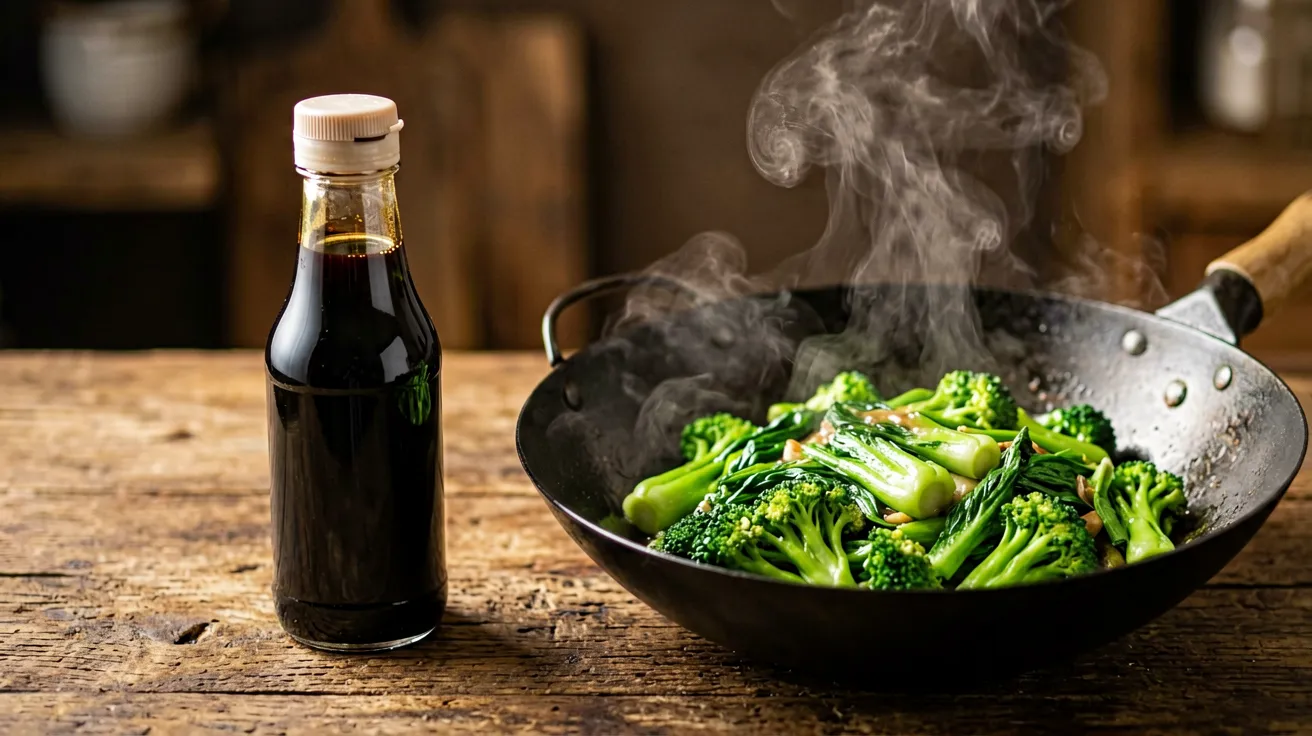
Oyster sauce (蚝油) does three jobs at once — it delivers nucleotide umami, it coats food in glossy viscosity, and it burns if you push the heat past ~170°C. Every substitute in this test won one or two of those battles and lost the rest. I learned this lesson the hard way. My partner and I had planned a Friday night gai lan stir-fry — the Chinese broccoli with oyster sauce that my grandmother made every Lunar New Year. I was out of oyster sauce. Confident that hoisin sauce would work (they're both thick, brown, and savory, right?), I substituted freely. The result was a dish that tasted like sweet plum sauce on vegetables. My partner took one bite and asked, "Did you forget the oyster sauce?" I hadn't. I had just chosen the wrong substitute.
That failure sent me into a structured testing protocol. I made the same dish — gai lan stir-fry — six times in one afternoon. Same pan, same heat, same timing, same everything except the substitute. My partner blind-tasted every version. Here is exactly what I learned.
Why Oyster Sauce Is So Difficult to Replace
Oyster sauce works through three distinct mechanisms that must all be addressed by any substitute:
- Oyster extract umami — specifically inosinate, a nucleotide that triggers savory receptors differently than glutamate (found in soy sauce). What is umami and why it matters — understanding the science of the fifth taste is the first step to successfully substituting it.
- High viscosity — from caramelized sugar and cornstarch, which creates the glossy coating that clings to vegetables
- Heat sensitivity — oyster sauce burns at approximately 170°C (340°F), meaning high-heat wok cooking requires careful timing
A substitute that nails one or two of these but fails the third will produce a noticeably inferior dish. This is why the ranked list below matters.
The 30-second answer: if you can find it, mushroom oyster sauce is the closest 1:1 swap (85-90%) — same gloss, same viscosity, slightly earthier. No mushroom version on the shelf? Stir 1 tbsp soy sauce + 1 tsp sugar + ½ tsp cornstarch into the dish at sauce stage for a 40-45% fix that restores the gloss but not the oyster depth. What you cannot fix with pantry items is the briny umami itself — that's the part worth a trip to the store.
Working through other hard-to-replace Chinese staples? The same tested approach applies to Chinese black vinegar substitutes.
Ranked Comparison: 6 Oyster Sauce Substitutes Tested
| Rank | Substitute | Compatibility % | What Changes | What to Fix | Verdict |
|---|---|---|---|---|---|
| 1 | Mushroom/Vegetarian Oyster Sauce | 85-90% | Earthy vs briny flavor | None needed | Best single-substitute option |
| 2 | Fish Sauce + Sugar + Cornstarch | 55-60% | More pungent, thinner consistency | Add cornstarch slurry, reduce quantity | Good for Southeast Asian dishes |
| 3 | Hoisin Sauce | 50-55% | Sweet-forward, no oyster umami | Add fish sauce or MSG | Acceptable with compensation |
| 4 | Soy Sauce + Sugar + Cornstarch | 40-45% | Lacks savory depth | Add MSG or mushroom powder | Pantry-staple emergency option |
| 5 | Coconut Aminos | 35-40% | Thinner, sweeter, lower sodium | Reduce sugar, add thickener | Avoid for stir-fries |
| 6 | Teriyaki Sauce | 30-35% | Ginger-forward Japanese profile | Wrong flavor direction entirely | Do not use for Chinese dishes |
Deep Dive: What Each Substitute Actually Changes
1. Mushroom/Vegetarian Oyster Sauce (85-90%) — The Winner
This is made from shiitake mushrooms, which contain guanylate — a nucleotide that produces umami through a different pathway than oyster's inosinate. The texture is identical: thick, glossy, with the same caramelized sugar base.
What changes: The flavor shifts from briny (oyster) to earthy (mushroom). In a blind test, my partner could tell the difference but rated it "equally delicious." For vegetable dishes, this is actually a superior choice because the earthy notes complement greens better than the briny oyster flavor.
Heat behavior: Same burn point as oyster sauce (~170°C). Add at the end of cooking.
Best for: Gai lan, bok choy, any vegetable stir-fry. Also vegan and vegetarian diets.
The catch: It costs 2-3x more than standard oyster sauce. Lee Kum Kee's mushroom version runs $6-8 per bottle versus $3-4 for the original.
2. Fish Sauce + Sugar + Cornstarch (55-60%) — The Seafood Option
Fish sauce brings seafood umami closer to oyster's profile than any plant-based alternative. The issue is concentration: fish sauce is roughly 3x more pungent than oyster sauce by volume.
The formula I tested: 2 tablespoons fish sauce + 1 tablespoon sugar + 1 teaspoon cornstarch dissolved in 2 tablespoons water. Simmer until thickened.
What changes: The initial aroma is significantly stronger — fish sauce hits your nose immediately. The flavor is brinier and less sweet than oyster sauce. My partner described it as "more fishy but still good."
Heat behavior: Fish sauce is more heat-stable than oyster sauce. It can handle higher wok temperatures without burning, which is actually an advantage for high-heat stir-frying.
Best for: Southeast Asian dishes — pad thai, larb, green papaya salad. Not ideal for Cantonese-style vegetable dishes where oyster sauce is the star.
3. Hoisin Sauce (50-55%) — The Common Mistake
This is the substitute I originally used, and it failed for a specific reason: hoisin sauce is built around fermented soybean paste and sugar, not seafood. The sweetness hits first and dominates.
What changes: Your dish becomes sweet-forward with garlic and five-spice notes. The viscosity is correct — hoisin is thick enough — but the umami profile is completely different. Oyster sauce provides savory depth; hoisin provides sweet complexity.
How to fix: Add 1 teaspoon fish sauce or 1/4 teaspoon MSG per 2 tablespoons hoisin. This compensates for the missing inosinate. My partner rated the fixed version at 65% — better, but still not right.
Best for: Char siu (Chinese BBQ pork) where hoisin is already a component. Avoid for vegetable dishes.
4. Soy Sauce + Sugar + Cornstarch (40-45%) — The Pantry Emergency
This is what you make when you have nothing else. The soy sauce provides salt and some umami (glutamate), but it lacks the nucleotide-driven depth of oyster sauce.
The formula I tested: 2 tablespoons light soy sauce + 1 tablespoon brown sugar + 1 teaspoon cornstarch dissolved in 1 tablespoon water. Simmer until syrupy.
What changes: The flavor is one-dimensional — salty-sweet without the complex savory finish. The color is lighter (brown vs dark brown). My partner said it "tastes like sweet soy sauce on vegetables."
How to fix: Add 1/4 teaspoon mushroom powder or MSG. This brings the compatibility up to about 55%.
Heat behavior: Cornstarch thickeners can break down if boiled too long. Add at the end of cooking and do not overheat.
5. Coconut Aminos (35-40%) — The Trendy Failure
Coconut aminos is marketed as a healthy soy sauce alternative. It is not an oyster sauce substitute.
What changes: The consistency is watery — it does not coat vegetables at all. The flavor is sweeter and tangier than oyster sauce, with a distinct coconut undertone that clashes with savory dishes. My partner described it as "fruity and wrong."
Why it fails: It addresses none of the three critical mechanisms. No inosinate, no viscosity, and the sugar content is lower so caramelization is weaker.
Best for: Absolutely nothing in the oyster sauce context. Use it as a dipping sauce or marinade base, not a stir-fry component.
6. Teriyaki Sauce (30-35%) — The Worst Option
Teriyaki sauce is a Japanese condiment built around soy sauce, mirin, and ginger. It is designed for a completely different flavor profile.
What changes: The ginger and sake notes dominate. Your Chinese stir-fry will taste Japanese. The viscosity is acceptable, but the flavor direction is irreparably wrong.
Why it fails: Teriyaki sauce adds flavors (ginger, garlic, sake) that are not present in oyster sauce and actively compete with the dish's intended profile. My partner identified this immediately and asked if I had "accidentally made Japanese food."
Best for: Chicken teriyaki. Not for any dish that calls for oyster sauce.
Heat Behavior: What Burns and What Doesn't
Oyster sauce burns at approximately 170°C. This is critical because high-heat wok cooking reaches 200-250°C. The solution is always to add oyster sauce (or its substitute) in the final 30 seconds of cooking.
| Substitute | Burn Point | Cooking Instruction |
|---|---|---|
| Oyster sauce (reference) | ~170°C | Add at end, 30 seconds |
| Mushroom oyster sauce | ~170°C | Add at end, 30 seconds |
| Fish sauce blend | ~200°C | Can handle higher heat |
| Hoisin sauce | ~180°C | Add at end, 30 seconds |
| Soy sauce blend | ~175°C | Add at end, 30 seconds |
| Coconut aminos | ~160°C | Burns fastest — add off heat |
| Teriyaki sauce | ~180°C | Add at end, 30 seconds |
Common Mistakes Specific to Oyster Sauce Substitution
Mistake 1: Using the substitute 1:1 without adjusting salt. Oyster sauce is saltier than most substitutes. Mushroom oyster sauce is comparable, but hoisin and coconut aminos are lower in sodium. You will need to add salt to compensate.
Mistake 2: Adding the substitute too early. Every substitute except fish sauce burns at similar temperatures to oyster sauce. Add in the final 30 seconds of cooking, toss quickly, and serve immediately.
Mistake 3: Ignoring the viscosity requirement. Thin substitutes (coconut aminos, soy sauce alone) will run off vegetables and pool at the bottom of the wok. Always thicken with cornstarch or reduce the liquid before adding.
Mistake 4: Choosing based on diet alone without considering flavor direction. Vegan does not automatically mean mushroom oyster sauce is the right choice. If you are making a dish where oyster flavor is critical (like oyster sauce chicken), no plant-based substitute will work. Accept the flavor change or choose a different recipe.
Who This Is For: Decision Matrix
| Your Situation | Recommended Substitute | Why |
|---|---|---|
| You want the closest match | Mushroom oyster sauce | 85-90% compatibility, same texture |
| You have no specialty ingredients | Soy sauce + sugar + cornstarch + MSG | Pantry-staple option at 55% with MSG |
| You are making Southeast Asian food | Fish sauce + sugar + cornstarch | Better flavor alignment |
| You only have hoisin sauce | Hoisin + fish sauce (1 tsp per 2 tbsp) | Brings it to 65% |
| You are vegan/vegetarian | Mushroom oyster sauce | 85-90% and plant-based |
| You are keto | Avoid all substitutes | Every option has significant sugar |
| You are gluten-free | Tamari + sugar + cornstarch | Same as soy sauce blend, use tamari |
Want the math on a swap I didn't test? Run it through the Substitution Calculator — it scores compatibility from the same flavor-vector data that drives these rankings.
I ran the same side-by-side protocol on Shaoxing wine substitutes and doubanjiang substitutes — same pan, same timing, same blind tasting. If you're substituting more than one pantry staple, the cluster holds up as a set.
What Not to Do + Final Recommendation
Do not use coconut aminos or teriyaki sauce for oyster sauce substitution. They change the dish's identity entirely.
Do not assume any substitute works 1:1 without adjustment. Every option requires testing with your specific recipe.
Do not add oyster sauce substitutes early in cooking. Heat destroys their flavor and thickeners.
My final recommendation: Buy mushroom/vegetarian oyster sauce. It costs more, but it is the only substitute that delivers the same cooking experience — same texture, same application, same heat behavior. The flavor difference (earthy vs briny) is noticeable but not disqualifying. If you cannot find it, use the fish sauce + sugar + cornstarch blend for seafood dishes or the soy sauce blend with MSG for everything else.
If you're building out the shelf that makes substitutions unnecessary, the Chinese Pantry Starter Kit walks through the first seven bottles that unlock the most dishes — mushroom oyster sauce included.
FAQ
Q: Can I use Worcestershire sauce as an oyster sauce substitute? A: No. Worcestershire sauce contains anchovies and tamarind, giving it a fermented, acidic profile that does not match oyster sauce's savory-sweet balance. Compatibility is below 30%.
Q: Is mushroom oyster sauce gluten-free? A: Most brands are not. Lee Kum Kee's mushroom oyster sauce contains wheat. Check labels carefully — some specialty brands offer gluten-free versions. For celiac-safe options, use tamari + sugar + cornstarch with MSG.
Q: Can I make oyster sauce from scratch? A: Yes, but it requires fresh oysters, soy sauce, sugar, and cornstarch — and takes 45 minutes. The result is 60-65% compatibility because homemade versions lack the precise caramelization and stabilizers in commercial products. Not worth the effort.
Q: What is the best vegan oyster sauce substitute? A: Mushroom oyster sauce (85-90%). It is made from shiitake mushrooms and contains no animal products. The second option is the soy sauce + sugar + cornstarch blend with added MSG (55% with MSG).
Q: Does oyster sauce need to be refrigerated after opening? A: Yes. Oyster sauce and all its substitutes (except soy sauce) should be refrigerated after opening. They contain sugar and moisture that can ferment at room temperature. Refrigerated, they last 6-12 months.
Q: Can I substitute oyster sauce with soy sauce alone? A: No. Soy sauce lacks the viscosity and sweetness that oyster sauce provides. Your dish will be watery, salty, and thin. Always combine soy sauce with sugar and cornstarch to approximate oyster sauce's texture and flavor.
On this page
- I Ruined a $25 Gai Lan Dinner Before I Learned the Truth About Oyster Sauce Substitutes
- Why Oyster Sauce Is So Difficult to Replace
- Ranked Comparison: 6 Oyster Sauce Substitutes Tested
- Deep Dive: What Each Substitute Actually Changes
- Heat Behavior: What Burns and What Doesn't
- Common Mistakes Specific to Oyster Sauce Substitution
- Who This Is For: Decision Matrix
- What Not to Do + Final Recommendation
- FAQ
Commerce Note
As an Amazon Associate I earn from qualifying purchases. Some outbound shopping links on this site are Amazon affiliate links and should be treated as paid links. Read the retailer disclosure.
Mushroom Oyster Sauce (Lee Kum Kee)
Test WinnerThe bottle I used in the winning test — Lee Kum Kee's mushroom oyster sauce. It's the one swap that cooks exactly like the real thing: same gloss, same burn point, same finish.
Why It Matters
At 85-90% compatibility, this is the single best substitute for vegetable dishes and stir-fries — the only one that needs no compensation and no extra steps.
Runs $6-8 per bottle versus $3-4 for standard oyster sauce. Worth it if oyster sauce is the star of your dish.
Amazon affiliate link. As an Amazon Associate I earn from qualifying purchases.
Chinese Pantry Starter Kit
Pantry SetupThe winning substitutes are all pantry staples. This shop guide walks through the first seven bottles that unlock the most dishes — so you stop needing substitutions in the first place.
Why It Matters
If you cook Chinese food regularly, the right shelf setup beats every emergency workaround. The substitutes that scored best in my test are the ones worth stocking.
Amazon affiliate link. As an Amazon Associate I earn from qualifying purchases.
Continue Exploring
Written by Mike Sang
Digital strategist, fermentation science enthusiast, and student of the Tao. Bridging growth engineering with ancient Chinese food wisdom.
Seasonal Context
Flavor changes with the season. Your cooking should too.
Missing Umami is part of The Way of Nature, a living system connecting food, timing, and seasonal practice.